Friendship World Trek Pvt. Ltd. Is established to give best services to the people who comes to visit the Nepal and Many other Purposes.. It is one of leading tours, operators and trekking and Travel agents in Nepal. Friendship World Trek staff team consists of trained, experienced and down-to-earth professionals. Our qualified bilingual and multilingual guides speak fluent English, French, German, Japanese and Chinese who will help you see, feel and experience Nepal.
Bahrain prince and expedition team successfully scale Mount Manaslu
The prince of Bahrain and his expedition team successfully scaled Mount Manaslu (8,163 meters) on Thursday.
According to the Department of Tourism (DoT), the liaison officer of the base camp informed the department about the successful ascent to Mt Manaslu. “Fourteen climbers from Bahrain and three mountain guides have successfully climbed the mountain at 7:10 am this morning,” an official at the department said.
The team including the prince of Bahrain Shaikh Nasser bin Hamad Al Khalifa had reached the base camp of Mt Manaslu on Tuesday. The expedition team has already ascended Mt Lobuche (6,119 meter) on October 3.
After the mountaineering activities were suspended due to COVID-19, the expedition team of Bahrain prince made the first ascent of 2020.
The government suspended spring season climbing as a precautionary measure for the safety of the climbers. Mountaineering activities resumed in July after a hiatus of nearly six months due to the COVID-19 pandemic. An 18-member expedition team including a member from the royal family and three nationals from the United Kingdom had arrived in Kathmandu on September 16. The DoT issued the climbing permit to the team on September 22.
The DoT has issued climbing permits to four teams for three mountains namely Mt BarunTse (7,129 meter),Mt Manaslu and Mt Gyalzen (6,151 meter). The department has collected Rs 1.91 million as royalty from expedition teams attempting to scale mountains this autumn.
A team of high-profile climbers led by Bahrain Prince Mohamed Hamad Mohamed Al Khalifa successfully scaled Mt Manaslu this morning, making it to the only summit of Nepal’s 8,000-metre peak in the autumn season
“The team members scaled the peak after they found a fair-weather window,” he informed.
The climbers started summit push last night from Camp III following the summit route prepared by a rope-fixing team of Sherpa climbers. “Bahrain nationals including prince Al Khalifa and three British citizens of the Bahrain Royal Guard Expedition along with the first South Asian to complete all 14 peaks above 8,000m Mingma Sherpa, Kami Rita Sherpa, Tashi Lakpa Sherpa and Sanu Sherpa reached the summit point of Mt Manaslu,” Guragai quoted climbers as sharing from the mountain.
The team members include British nationals Richard Warren McConnel, Phillip Clough and Christopher Anthony. Bahrain nationals in the team include Ebrahim Mohamed Abdulla Ebrahim Mohamed, Mohamed Ali Jasim Ahmed Alboainain, Arafat Hamood Naji Ghurbah, Ebrahim Khalil Ebrahim Zayed Mohamed Aljazzaf, Ahmed Said Ahmed Isa Alkabbi, Arif Feroz Shah Murad Qalunder Ghulam, Mohamed Adul Rahman Yusuf Alkawari, Khaled Ali Hasan Ebrahim Hasan Aldossery, Abdulaziz Rafea Abbar Khalaf Alabed, Khaled Sultan Mohamed Abdulla Alsheerwai, Murad Mohamed Yusuf Abdul Sayed, Ebrahim Ali Salem Jaber, Saud Hamad Mubarak Hamad Eid and Mohamed Isa Abdulla Yusuf Alqais.
Tamara Hardingham-Gill, CNN • Updated 12th October 2020
(CNN) — It might not seem that way when you read harrowing accounts of climbers perishing on its treacherous slopes, but there's an easy way to climb Everest, and there's a hard way.
Nate Menninger, a young adventurer from Boston, definitely took the hard way.
Rather than the hike up the world's tallest peak, like most trekkers, with the support of an organized climbing outfit, the 26-year-old decided to take a job as one of the first-ever non-native Everest porters.
That meant being paid $15 a day for hauling gigantic packs weighing up to 220 pounds (100 kilograms) along rugged, high altitude trails, huddling with fellow porters in freezing huts at night for rest, and sharing their basic rations.
Along the way, he made a film about his experiences, which he hopes will shine a light on the largely unsung work of Everest porters and the precarious way they eke out a living in one of the planet's toughest environments.
Harsh reality
In 2019, Nate Menninger became one of the first foreign-born porters on Mount Everest.
Menninger came up with his idea to become a porter after spending a season working as a guide in Nepal, teaching himself Nepalese and becoming fascinated with the work and lives of these human hauliers.
Equally fascinated by Everest, but unable to afford the tens of thousands of dollars needed to cover the cost of the permit and support needed to reach the summit, he hit upon an idea to climb it for free.
"When I was guiding that summer, I saw how porters lived for the first time," he tells CNN Travel. "I saw them sleeping on the floor. I saw how they ate, and how strong they were.
"And I realized if I climbed Everest as a porter, I wouldn't have to pay $35000 to $65,000. I would actually get paid to climb Everest.
"That was the only feasible way I could attempt the mountain at the age I was."
Menninger eventually scaled back his original plan to reach the top of Everest, settling for making a film about his time among the porters on the still arduous 11-day hike from the town of Lukla, at 9,400 feet above sea level, to Everest Base Camp.
"My goal was to have the exact same experience as the porters no matter what," he explains. "I wanted to see if I could handle what it's like to have this job and if I could be as strong as a porter has to be."
His grueling experience is chronicled in the hour-long documentary "The Porter."
Climbing the height of Mount Everest from the comfort of your own home
Physically demanding work
Porters are required to carry packs, known as badis, to supply the region with necessities.
The physical and emotional toll of the job is laid bare as Menninger is captured struggling with the weight of a pack that consisted of multiple bags lashed together, then trying to sleep at night in crowded porterhouses.
Subsisting mainly on a diet of rice with lentils, he lost over 20 pounds over the course of the expedition and didn't shower for more than three weeks.
Menninger says he tried to fully embed himself into the lives of the porters, but accepts his experiences only scratched the surface.
"It's not a sight you see a lot over there," he explains. "I tried to take the worst scenario possible every time. If the other porters were sleeping on the floor, I wanted to sleep on the floor.
"I just wanted to be another guy in the room while people were doing their thing."
It wasn't just his appearance -- a muscular six-foot-plus that towered over his Nepalese colleagues -- that set him apart. It was also the temporary nature of his new job.
"I had a very different experience than a normal porter would because I was just coming in for one trip," he says. "It was just a snapshot. I wasn't really relying on the money.
"And in terms of everything that they go through, I'm just experiencing a fraction of the emotion and the physical output."
A typical day would involve waking up at around 7:30 a.m. and going to the client's hotel to collect their bags, before tying the bags together and beginning to trek.
"One porter carries two clients' bags, that's how it works," he says. "You move very quickly. Most of the day, you're looking down."
Menninger hauled packs consisting of multiple bags lashed together.
Babin Dulal/'The Porter'
Porters have to pay for their own food and accommodation during expeditions, and Menninger says some regularly forgo meals in order to keep costs down.
"If you want to survive, you have to try to save the money you spend on food," he says. "One porter would cut his rations in half. He would eat half meals to save money."
While working an expedition, porters will spend around $7 a day on food and housing, and the charges rise the further up the mountain they go.
"By the end your costs are over $20, so you're actually losing money while you're working," he says. "So you really rely on tips."
As porters aren't tipped until day 11, they essentially have no idea whether the expedition has been financially worthwhile until they've more or less completed it.
Menninger made $15 a day during his 11-day expedition and he and his fellow porters, who mostly hail from villages near Base Camp, received a $100 tip each.
Menninger visibly struggled with his load during the filming.
Babin Dulal/'The Porter'
"Some people tip well, some don't," he says. "At that point, it's just the luck of the draw, whether you make $500 dollars or $50. It just depends on your expedition."
They receive their tip on the final evening of the expedition but work a 12th-day "pro bono" to escort the climbers to the airport.
"Then the next day, or maybe a few days later you'll go on another expedition," he adds. "And you could do that five or six times in a season back to back."
Since returning to the United States last year, Menninger has remained in contact with the porters he worked with during his time at Everest.
He admits to being apprehensive about showing his former colleagues the completed film.
"It was very nerve-wracking," he says. "I was very, very worried about what they'd say, because it was [showing] their job on an international scale. But they said it wasn't tough enough."
World's highest mountains -- and size-isn't-everything alternatives
Local-foreigner divide
Menninger's experiences on Everest are documented in the film "The Porter."
Babin Dulal
Back on Everest, life isn't getting any easier for the porters. The Covid-19 pandemic has impacted the region's mountaineering industry, which generates around $300 million for Nepal every year.
The mountaineering industry that surrounds Everest has been under added scrutiny after 2019 was plagued by overcrowding, with climbers becoming stuck in a queue to the summit, above the peak's highest camp at 26,247 feet.
There were at least 11 deaths, making it one of Everest's deadliest climbing seasons, a high death toll largely attributed to difficult weather conditions, lack of experience, and the growing commercialization of expeditions.
Adding to the problems, says Menninger, is a lack of communication between the porters and their mostly wealthy clients.
"The guides speak a little bit, but porters don't really speak to their clients at all and clients don't speak to their porters.
"So there's no cultural exchange. Usually, with traveling, you go somewhere to learn more. To meet other people and exchange ideas."
He's seen the divide between locals and tourists first hand and believes the lack of communication has created many issues.
"There's this separation between our mountain and their mountain," he continues.
"Their trash and our trash. It's a terrible way to treat the situation."
While he's loath to tell potential climbers what a good or a bad tip is, Menninger wishes more were aware of how much porters rely on the money due to their low salaries, as well as how much workers contribute to the overall Everest experience.
"The people that live there make everything possible," he says. "Even if you go and don't have a porter and just carry your own bags.
"Everything you enjoy, the hotel, the restaurant. Everything has pretty much been carried by a porter at some point.
"So whether you are using a porter or not, you're benefiting from their work. So make sure you talk to your porter. Find out how much they're making. Ask and be curious."
The Porter: The Untold Story at Everest from Nate Menninger on Vimeo.
Menninger says he was "very humbled" by his experiences with the porters, particularly as someone from a relatively wealthy background, and hopes his film will elevate the porters of Everest by demonstrating what they're able to endure and how hard they work.
"Even if you go to Everest, you will not see where your porters sleep. The movie is the first time you'd see this.
"I wanted to show that these people were strong, proud, and powerful and that anyone can have pride in any job in the world," he adds.
Menninger's documentary "The Porter: The Untold Story at Everest" is available to view on Vimeo.
Nepal waives off quarantine and COVID insurance provision for tourists visiting Nepal after 17 October
9th Oct 2020 |
Kathmandu: Nepal is all set to open borders for International tourists from 17 October.
The proposal presented by the Ministry of Culture, Tourism and Civil Aviation on the cabinet meeting at the Prime Minister's residence has been approved. Now a foreigner with 17 hours prior to the Covid-19 negative report can travel to Nepal. The foreigner is no longer required to stay seven days of hotel quarantine.
However, tourists should undergo an instant PCR test at Tribhuwan International Airport. The government also plans to waive off 500$ COVID Insurance but the foreigner should assure that they will cover their medical expenses themselves.
Foreigners fulfilling the criteria will be provided on arrival visas at the airport after October 17.
The Ministry of Culture, Tourism and Civil Aviation has confirmed that they are ready to issue new protocols for tourists visiting Nepal and the protocols will be released after confirming with the Covid-19 Crisis Management Centre.
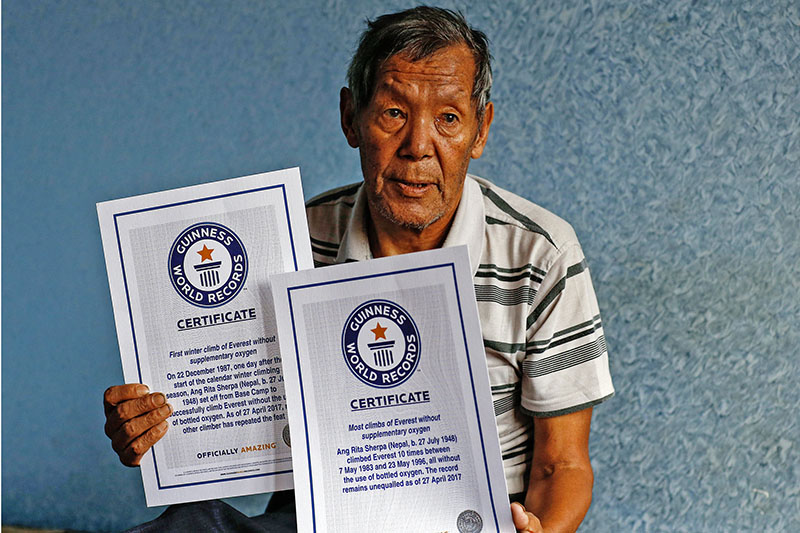
Ang Rita Sherpa, popularly known as the ‘snow leopard’ in the mountaineering community, has passed away this morning, according to family sources.
Ang Rita Sherpa (Snow Leopard)
He was 72. “The legendary climber breathed his last at around 10:40am at his residence in Jorpati,” his neighbor Mingma Sherpa, who is also chairman at Yambu Thamichho Kydug, confirmed. Ang Rita is survived by two sons and a daughter. The reason behind his death is not known yet. Sherpa was awarded a Guinness World Record certificate for making the most number of successful ascents on Mt Everest without using the supplemental oxygen.
Sherpa made it to the top of the world for the 10th time in 1996 without using bottled oxygen. Ang Rita reached the summit of Mt Everest eight times via the Southeast Ridge route, according to a record maintained by the Department of Tourism.
Ang Rita has received two Guinness World Records for the most climbs of Mt Everest without supplementary oxygen i.e 10 times and the ”His first winter climb of Mt Everest without supplementary oxygen was in 1987.”
Lonely Planet ranks Nepal’s Everest base camp as 4th best trek in the world
The trail passes through Sherpa villages, glaciers, and finally to the lap of Mt Everest, the world's highest mountain.
The Everest base camp trek that passes through Sherpa villages, glaciers, and finally to the lap of the world's highest mountain–Mt Everest–has been ranked 4th best treks in the world by Lonely Planet, the leading travel guide book publisher in the world.
‘The 10 best treks in the world’ updated in June 2020 by the guidebook says everybody wants a glimpse of the world’s highest mountain and that’s the reason why the Everest base camp trek has become so popular.
“Reaching a height of 5,545m (18,193ft) at Kala Pattar, this two-three-week trek is extremely popular, thanks to its spectacular scenery but also romanticism; successful trekkers are able to proudly say they've stood at the base of the world's highest mountain,” the guidebook said.
The trail threads between small, characterful mountain villages en route to the famous campground and are trafficked by Sherpa people of the Solu Khumbu.
“The heights reached during this trek are literally dizzying until you acclimatize to the altitude, and the continuous cutting across valleys certainly has its ups and downs. Be warned: prime trekking season brings serious crowds.”
Most of the trek is through the Sagarmatha National Park, a UNESCO World Heritage Site (Sagarmatha is the Nepali name for Everest) and a refuge for musk deer, snow leopard, Himalayan tahr, black bear, and many spectacular types of iridescent pheasant.
Among the top 10 lists of the world's best trek, Everest base camp trek trails behind the GR20 trail that goes through Corsica, France diagonally from North to South; Inca Trail in Peru and Pays Dogon in Mali, one of Africa’s most breathtaking regions.
Other best treks are—the Indian Himalayas in India; Routeburn Track in New Zealand; Overland Track in Australia; the Narrows in the US; the Haute Route in France-Switzerland and Baltoro Glacier & K2 in Pakistan.
The travel guidebook says that these 10 classic treks are amongst the best on the planet; all of them require a sturdy pair of lungs, fit legs, and a good amount of preparation. But the reward is an experience that lasts a lifetime.
According to Lonely Planet, Mount Everest has captivated intrepid men and women since the 1920s. The exploits of legends such as George Mallory, Sir Edmund Hillary, and Tenzing Norgay Sherpa put the mighty mountain on the map; thousands have followed, making huge sacrifices – many with their lives – in their own attempts to the summit.
But today, the trek to Everest base camp has become an achievable goal for people from all walks of life who want a glimpse of the world’s highest peak. In 2018, more than 56,000 people trekked in the Everest region.
With no clear plan from the government, Nepal may remain closed for tourists until 2020-end
With the festival season approaching and a large number of Nepalis, including migrant workers expected to return home, government officials said it will be difficult to manage tourists.
With the coronavirus spikes showing no sign of abating anytime soon, Nepal is likely to remain shut for foreign tourists until the end of this year.
But as the country is bracing for a major festival season, there is a high chance of people’s movement, not just within the country but also internationally.
Officials at the Tourism Ministry say given the festive season, which will mean Nepalis in hordes will be arriving, it will be difficult to manage foreign tourists in light of the rising number of Covid-19 cases.
“We expect Nepalis, including migrant workers, to return home soon,” said an official at the ministry, who did not wish to be named. “The situation is that the country is experiencing a rapid spread of the virus.”
According to him, sooner or later, an announcement is likely.
After five months, Nepal opened its skies for international flights starting Tuesday, allowing limited regular passenger and chartered flights. Only Nepalis and diplomats and employees of development partners are allowed to fly into Nepal for now.
The government’s move to continue with restrictions on foreign holidaymakers even after resuming international flights has renewed worries of travel trade entrepreneurs.
In a statement on Sunday, the Nepal Association Tour Operators called on the government to quickly come up with a plan to save the 1.05 million jobs which are in danger of being lost, some permanently, in the tourism industry.
The association said that tourism-related businesses have been operating on negative cash flow since late March and this is not a situation that can be sustained for long.
“Most indicators are that tourism’s road to recovery will be long and drawn out with traveller numbers reaching 2019 levels only in 2024,” said the association. “Travel industry sector companies cannot be expected to sustain themselves for such a long time without active support from the government.”
As of Tuesday, Nepal has reported 40,529 coronavirus cases and 239 deaths. As many as 1,069 new cases were reported across the country on Tuesday, with a record 481 in Kathmandu Valley. Tuesday’s death toll was 11.
Even though the government decided to lift the lockdown on July 21, the health and foreign affairs ministries were not positive about opening the country for foreign tourists, according to Tourism Ministry officials.
“During Covid-19 Crisis Management Centre meetings, the Foreign Affairs Ministry reiterates that it cannot afford to issue on-arrival visas for foreigners at this time of crisis. Health Ministry officials, too, support this view saying that it’s not an appropriate time to host tourists,” a tourism ministry official said on condition of anonymity because he is not allowed to speak to the media.
At a time when the pandemic has upended daily life across the globe, travel and tourism industries worldwide are struggling, and the situation is no different in Nepal, say industry insiders
However, they have been calling on the government to at least come up with some work plan for the road to recovery.
“Most of the countries are clear regarding the timetable to open up for tourists, and that assures the travel trade industry to be well prepared,” said Ashok Pokhrel, president of Nepal Association Tour Operators, the umbrella organisation representing tour operators. “But in our case, decisions have been made without enough thought.”
The Indonesian island of Bali recently announced that it will not open to foreign tourists this year due to coronavirus concerns.
Similarly, Thailand has announced restricting tourists to many major sights in the country until 2021. However, last week, Thailand announced it hopes to allow limited numbers of international travellers to visit certain parts of the country from October through a programme called ‘Safe and Sealed’.
China had last week announced a temporary ban on all foreign visitors, even if they have visas or residence permits. The northern neighbour is also limiting each Chinese and foreign airline to one flight per week.
“We know how weak our health infrastructure system is. In this scenario, we cannot assure our foreign clients to come but the least the government can do is come up with a precise plan,” said Pokhrel. “And amid this, the government comes up with revised decisions every week, adding to our confusion.”
On July 20, the government said that international and domestic flights will resume from August 17, and asked the travel and tourism industry to take bookings for the autumn tourism season accordingly.
A month later, on August 21, the government decided to resume chartered and regular passenger flights from September 1.
However, only Nepalis and diplomats and employees of development partners would be allowed to fly into Nepal, with restrictions on foreign tourists until further notice, the Cabinet decided.
Then on Sunday, the government decided not to open domestic flights until September 16.
Meanwhile, Tourism Ministry Joint Secretary Buddhi Sagar Lamichhane said they have revised the list of chartered and regular flights scheduled to slightly increase the flight frequencies after criticism from Nepali missions abroad, saying that that would delay the rescue of stranded Nepali workers.
On August 10, the government had capped the daily arrivals at 500 individuals, which prompted airlines to jack up airfares due to limited availability of seats. The Cabinet meeting on Sunday decided to increase this to 800 individuals.
“Flights have been increased keeping in mind particularly foreign companies sending Nepali workers to Nepal at their own expenses,” said Lamichanne. “Such companies have to request Nepal beforehand to operate the flights required to repatriate Nepali migrant workers.”
Travel and tourism operators say they are hoping that the government will come up with something, given how the economy has taken a beating.
The tourism sector contributes around 8 per cent to the economy and provides jobs to around a million of people.
A study entitled Rapid Assessment of the Social and Economic Impacts of Covid-19, commissioned by the UN Development Programme in Nepal and conducted by the Institute for Integrated Development Studies, said with international travel restrictions and fall in discretionary disposable incomes worldwide, tourism receipts in Nepal are projected to fall by 60 per cent in 2020, resulting in a loss of foreign currency earnings worth $400 million.
Similarly, Nepal’s central bank’s survey shows that the four-month-long lockdown imposed by the government has forced the hotel and restaurant industry, which saw almost zero visitors since the lockdown, to lay off 40 per cent of employees. According to the survey, hotels and restaurants cut employees’ salaries by 36.4 per cent.
Arrivals during the months of April, May, June and July numbered 13, 30, 100 and 195 individuals respectively, almost all of the diplomatic personnel. Nepal welcomed more than 70,000 visitors during each of these four months last year.
The tourism industry has never seen such a catastrophe since the first foreign sightseers began arriving in the 1950s after Nepal opened its doors to the world establishing direct air links with several Indian cities.
Tourism entrepreneurs say things weren't this bad even during the Maoist insurgency from 1996 to 2006 and the aftermath of the 2015 earthquakes.
The virus has dealt a knockout blow, and the once-booming tourism sector is unlikely to get back on its feet any time soon, travel trade entrepreneurs say.
Pokhrel, the tour operator, said that the government should say clearly how long the country would have to restrict the foreign tourists.
“The announcement, at least, will clear doubt that the tourism industry will open or not.”
India to Honor Mountaineer Who Faked Everest Summit?
Here’s an interesting story brought to my attention courtesy of the Adventure Mountain blog. The site, which is run by longtime adventure sports journalists Stephen Nestler, says that on Sunday, India will hand out its annual National Sports Awards for 2020. Among those being honored is a young man by the name of Narender Singh Yadav, who claims to have climbed Mt. Everest back in 2016 at the age of 21. That would make him the youngest Indian summiteer ever, granting him celebrity status and great opportunities I his home country. The problem is, it seems that Singh Yadav never reached the top at all and even went so far as to photoshop his alleged summit photo.
According to the Indian mountaineer—who says he has climbed five of the Seven Summits—he reached the highest point on the planet on the morning of May 2o, 2016. But, his expedition Sherpa was none other than Lhakpa Sherpa, who adamantly denies that Singh Yadav summited with him that day. In fact, there are reports that he never reached higher than The Balcony on the South Col route, which would put him at roughly 8400 meters (27,559 ft). It takes a big effort to reach that point on the mountain, but it also well below the summit.
If that wasn’t enough, several other Sherpas—including Nims Purja—say that they assisted Singh Yadav on the decent, providing him with emergency oxygen bottles to help him reach Camp 4. Despite the fact that a number of people have spoken out about this, Singh Yadav’s claims have largely gone unchallenged back home, thanks to what Lhakpa Sherpa calls “dirty politics.”
As further proof of the Indian’s false claims, Nepalese newspaper Ekantipur recently took a look at Singh Yadav’s summit photo. What they found was something akin to one of those “spot the things that are wrong” puzzles. The obvious highlights were the fact that the young man was wearing a climate helmet on the summit, fake shadows pointing in the wrong direction, and an oxygen mask that doesn’t have a tube attached, amongst other issues. Clearly the photo was forged, casting further doubts on the young man’s summit claims. Check it out above to have a good laugh.
Despite all of this evidence however, Singh Yadav is still set to receive his award from the Indian government. The irony of it is, that award is called the “Tenzing Norgay National Adventure Adventure Award,” obviously named after the Sherpa who was the first to climb Everest alongside Sir Edmund Hillary in 1953. As you can imagine, that hasn’t sat well with Nepali climbers. Whether or not that really matters remains to be seen.